
I’ve been staring at TV spec sheets for longer than I’d like to admit. And for years, the answer felt obvious — OLED wins, full stop. Perfect blacks, silky motion, gorgeous contrast. Done. But something shifted in the last year or two that made me genuinely reconsider that position, and I think a lot of people buying TVs right now are walking into stores (or scrolling through listings) with outdated assumptions.
Two Very Different Ideas of “Perfect”
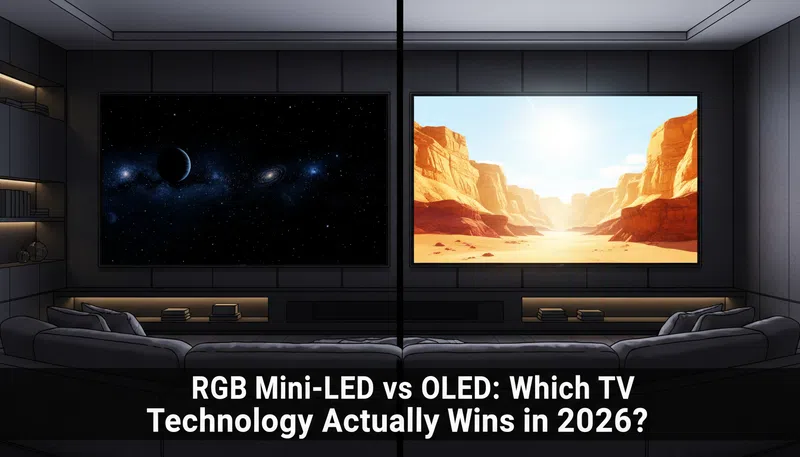
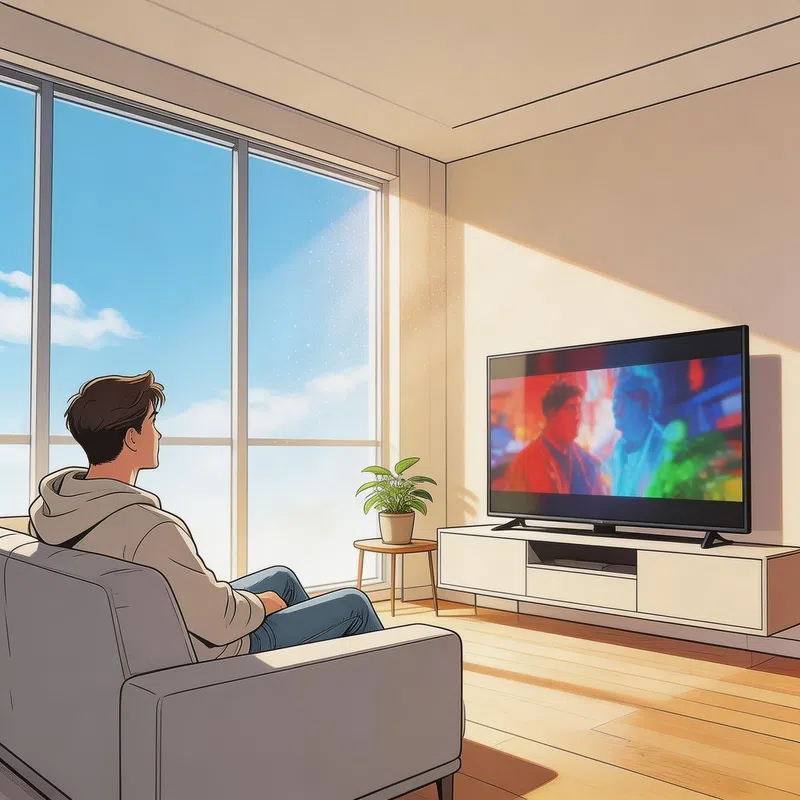
Here’s the thing about display technology — “best” is almost entirely contextual. What looks jaw-dropping in a pitch-black screening room can look genuinely washed out in a bright living room at 2pm on a Sunday with sunlight hitting the screen sideways.
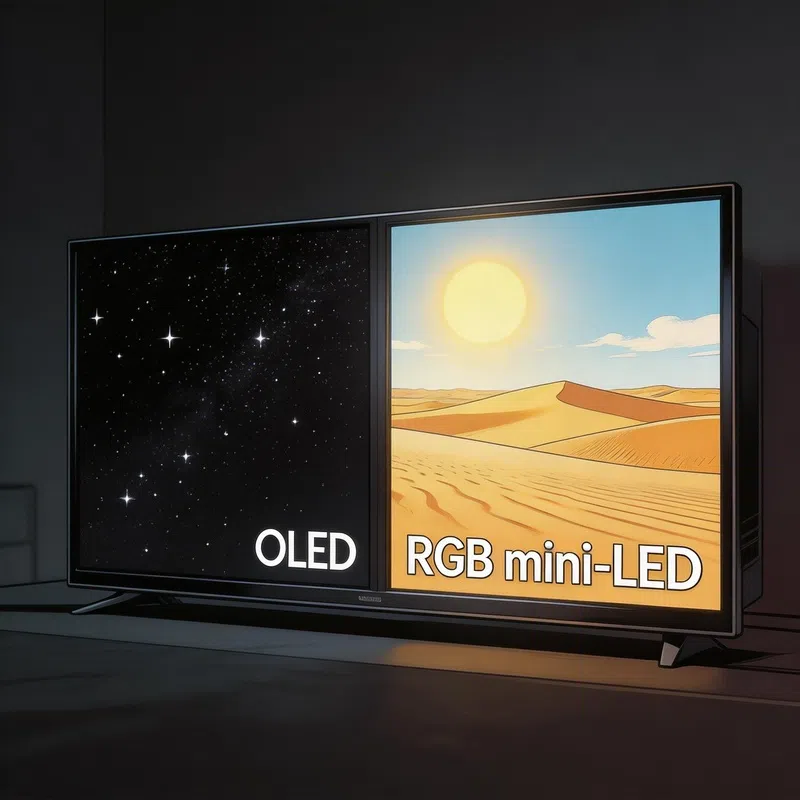
OLED does one thing better than anything else on the market: it turns individual pixels completely off. Absolute black. Not “very dark grey.” Off. The contrast that creates is something you feel in your gut when you first see it.
RGB mini-LED takes a completely different approach. Instead of self-emissive pixels, it uses thousands of tiny red, green, and blue LEDs as a backlight — which sounds like a step backward until you see the brightness numbers.
We’re talking 6,000 to 8,000 nits on flagship models. OLED tops out around 4,500 nits under ideal testing conditions, and real-world flagships tend to land closer to 2,100–2,300 nits. That gap is not subtle.
The Numbers Side by Side
Here’s a quick look at how these two technologies compare at the flagship level in 2026:
| Metric | OLED (Flagship 2026) | RGB Mini-LED (Flagship 2026) |
|---|---|---|
| Peak HDR Brightness | 2,100 – 4,500 nits | 6,000 – 8,000 nits |
| Full-Screen Brightness | ~390 nits | 1,000+ nits |
| Contrast Ratio | Infinite (pixel-level) | Up to 1,000,000:1 |
| Response Time | 0.03ms – 0.1ms | 2ms – 10ms |
| Color Gamut | Reference grade | 95–100%+ BT.2020 |
| Burn-in Risk | Real (with static content) | None |
| Viewing Angle | Excellent | Noticeable falloff |
The response time difference is significant for certain use cases — more on that in a moment.
Burn-in: Still a Real Conversation
Manufacturers will tell you burn-in is a solved problem. And to be fair, it’s gotten much better. Lifespan estimates from the brands themselves sit somewhere between 50,000 and 100,000 hours, which sounds like “don’t worry about it” territory.
But independent stress testing tells a different story. Real-world tests have shown measurable permanent image retention after about 18 months of heavy, static-content use — news channels running the same ticker, sports broadcasts with persistent overlays, that sort of thing.
If your TV is mostly movies and varied content, you’re probably fine. If you game for eight hours with a heads-up display always on screen, or you use it as a PC monitor with a static taskbar — that’s where I’d genuinely hesitate.
RGB mini-LED doesn’t have this problem at all. Inorganic LEDs don’t degrade the same way organic materials do. The backlight fades uniformly over tens of thousands of hours, but there’s no risk of a logo ghosting itself permanently into your panel.
For Gamers: It’s Not a Simple Answer
Fast-action competitive gaming — OLED still wins here. The response times are genuinely on a different level. 0.1ms gray-to-gray versus 2–10ms on mini-LED might not sound huge, but in motion-heavy scenarios it translates to less ghosting, cleaner tracking, and a more precise visual experience.
That said, if you’re playing slower-paced games, open-world titles, or anything where immersion matters more than response time, the brightness and color volume of RGB mini-LED creates an experience that honestly feels more cinematic. It’s a different kind of impressive.
For Professional Work
This is where RGB mini-LED pulls significantly ahead. HDR mastering, color grading, financial trading setups — anything requiring sustained high brightness for long periods. OLED throttles its brightness under sustained load to manage heat. RGB mini-LED holds 1,000+ nits across the full screen indefinitely.
OLED has the edge if you’re doing precision design work with logos, fine detail, or high-contrast graphics where the “halo effect” from mini-LED’s local dimming zones would be distracting.
The Blooming Problem Nobody Talks About Enough
Local dimming on mini-LED has improved enormously. Some flagship panels now have over 1,000 dimming zones. But the halo effect — bright light bleeding into adjacent dark areas — hasn’t been fully eliminated.
Watch a white text credit sequence against a black background on an RGB mini-LED TV and you’ll see a subtle glow around the letters. On OLED, that same scene looks like text floating in actual darkness.
It doesn’t ruin the experience. In my opinion it’s barely noticeable on modern flagship panels with dense dimming zones. But it exists, and it’s worth knowing about before you spend significant money.
So Which One Do You Actually Buy?
I used to think this was a personality question — are you a “pure image quality” person or a “practical real-world” person? But it’s more specific than that.
Choose OLED if:
- Your room gets dark or you control the lighting
- You watch a lot of film and want the most cinematic experience possible
- You game competitively and response time matters
- Your content is varied enough that burn-in isn’t a realistic concern
Choose RGB Mini-LED if:
- Your living room has significant natural light and you’re not covering those windows
- You need sustained brightness for professional work
- A news channel or sports channel with a persistent graphic is on for hours daily
- You want “vibrant and punchy” over “deep and precise”
The size landscape is also shifting. RGB mini-LED is no longer confined to 100-inch screens — 55-inch models are arriving in 2026, and as manufacturing scales up, prices should follow a faster downward curve than OLED historically has.
There’s no universally correct answer here, and honestly I’d be skeptical of anyone who tells you otherwise without asking about your room first. The technology that looks extraordinary in a showroom under controlled lighting might frustrate you at home. Worth thinking about before you tap “buy.”