

I’ll be honest — I bought a smart bulb starter kit three years ago thinking it would transform my electricity bill. It did not. What it did was introduce me to an app I had to update every six weeks and a subscription tier I didn’t notice I’d agreed to.
That experience made me a lot more selective. And a lot more interested in which smart home devices actually close the gap between what they promise and what shows up on a bill.
The short version: some of them genuinely work. Some are clever convenience sold as savings. The difference matters more than most buying guides admit.
Start With Heating — It’s Where the Real Money Is
Heating and cooling account for roughly half of a typical household’s energy use. Half. Which means if you’re going to spend money on anything smart, the climate system is where the math actually works in your favor.
Smart Thermostats Are the One Device Worth Buying First
The EPA puts the average savings at around 8% on heating and 10% on cooling. Real-world data tends to cluster between $130 and $145 annually, which isn’t dramatic until you factor in that most decent smart thermostats cost between $100 and $250 and pay for themselves within a single heating season.
What makes them smarter than a programmable timer isn’t just the scheduling — it’s that they check outdoor temperatures before deciding when to start. On a mild morning, a smart thermostat might delay kicking on by 45 minutes compared to a dumb timer set to a fixed time. Over a winter, those 45-minute delays accumulate into real numbers.
Add room sensors, and you can stop heating the guest bedroom nobody is using. That alone trims another 5–10% on top of the baseline savings.
One thing that trips people up before purchase: check whether your HVAC system has a C-wire. It’s a common wire in most systems built after the early 2000s, but older homes sometimes don’t have one routed to the thermostat location. Without it, some thermostats won’t get a consistent power supply and will behave unreliably. Most manufacturers sell adapter kits, but it’s worth knowing before you open the box.
Radiator Valves for Room-by-Room Control
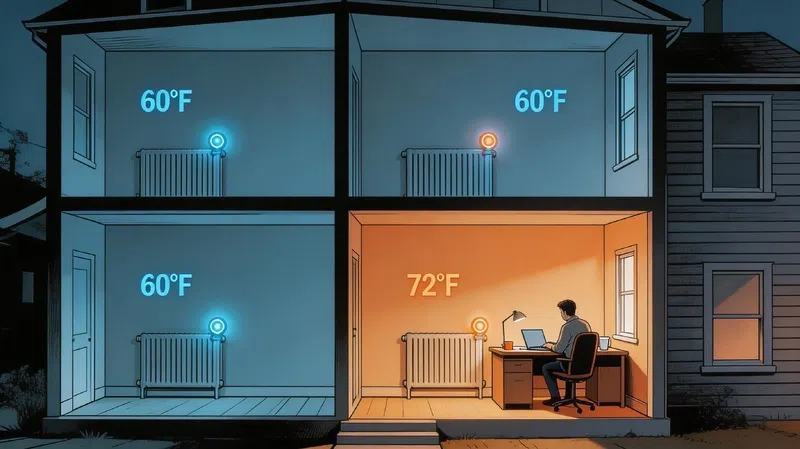
If you have a radiator-based heating system, smart radiator valves let you control individual rooms independently — which is a different problem from what a central thermostat solves. If you work from home and only genuinely need one room warm, zoning down the rest of the house while you’re in it can be surprisingly effective.
They’re not cheap — typically five times the cost of a standard valve — and most require a matching hub and smart thermostat from the same brand to communicate properly. The ecosystem lock-in here is real. This is one of those purchases that commits you to a platform whether you intended that or not.
The Devices Most People Overlook
Smart Plugs Are Boring and Quietly Useful
The average household has over 40 connected devices. A significant portion of them are drawing power right now, while turned “off.” Standby power — sometimes called phantom load or vampire power — accounts for somewhere between 5–10% of residential electricity. Across the US, that adds up to an estimated $19 billion annually in electricity that powers nothing useful.
Smart plugs fix this by physically cutting power rather than just entering standby. The most effective use is on entertainment centers and home office setups — equipment that tends to draw more standby power and tends to cluster around a single outlet strip. Program them to cut power at midnight, restore it in the morning. Done. No interaction required after setup.
They won’t transform your bill on their own. But combined with a thermostat, the incremental savings start to feel less incremental.
Whole-Home Energy Monitors Deserve More Attention
Products that clip onto your electrical panel and track consumption by circuit — brands like Sense or Emporia — aren’t glamorous. They don’t automate anything. What they do is show you, in real time, what’s actually drawing power in your home.
Real-time feedback alone has been shown in studies to reduce consumption by 5–15% just from changing behavior. When you can see that the old refrigerator in the garage is drawing as much power as everything else in the kitchen combined, you make different decisions. It’s less of a smart device and more of an information tool, but the ROI on behavior change is underrated.
Smart Devices That Save Money: What Actually Works
| Device | Realistic Savings | Key Requirement | Payback Period |
|---|---|---|---|
| Smart Thermostat | 8–15% on HVAC | C-wire compatibility | ~1 heating season |
| Smart Plugs | 5–10% on standby loads | High-draw idle devices | 1–3 months |
| Smart Radiator Valves | Variable — best for WFH | Matching ecosystem hub | 1–3 years |
| Leak Detector + Shutoff | Insurance discounts + damage prevention | Professional install for main line | Immediate on insurance |
| Smart Irrigation Controller | 30–50% outdoor water reduction | Stable Wi-Fi outdoors | 1–2 seasons |
| LED Smart Lighting | 75–85% vs incandescent | Best in high-use rooms | 3–6 months |
Water — The Category People Sleep On
Leak detection isn’t exciting until you’ve had a slow pipe leak quietly damage a wall for three weeks before anyone noticed. Systems that monitor flow, pressure, and temperature around the clock — like Moen Flo, which has solid independent coverage at Consumer Reports — can catch micro-leaks before they become insurance claims.
The financial case is partly the damage prevention itself and partly the insurance side. A meaningful number of insurers offer premium discounts for homes with automatic shutoff systems, and some will provide documentation letters for your policy. Worth calling your insurer directly before purchasing — the discount sometimes pays for the device.
Smart irrigation is the other underrated one. Outdoor watering accounts for up to 50% of residential water use in warmer states, and traditional timers run regardless of whether it rained yesterday. Controllers from brands like Rachio use local weather forecasts and soil sensor data to decide whether watering is actually necessary. The reduction in outdoor water use — documented extensively by the EPA’s WaterSense program — typically falls between 30–50%, which on a large lot in a dry climate is a meaningful number.

The Part the Marketing Doesn’t Lead With
Here’s what I wish someone had told me earlier: smart home devices that save money introduce their own costs that don’t appear in the headline savings figures.
Subscription creep is the main one. Features that were included at launch get quietly moved behind paid tiers. Cloud-based systems that worked fine for two years sometimes stop working when a manufacturer discontinues a product line or gets acquired. And the ongoing cognitive overhead of managing updates, re-authenticating accounts after firmware changes, and fixing broken automations is real, even if it’s not financial.
The most reliable devices tend to be the ones with local control — meaning they function on your home network without depending on a manufacturer’s cloud server. For everything else, it’s worth checking support timelines before you commit. Some brands like Tado offer 10 years of software support. Others stop at two years from the last sale date, which on a device you expect to run for a decade is a meaningful difference. The Verge’s smart home coverage and Which? UK both do reasonably good long-term tracking of manufacturer support records if you want to research specific brands.
Choosing an Ecosystem: The Decision That Outlasts the Device
Committing to Apple HomeKit, Amazon Alexa, or Google Home doesn’t feel like a big decision when you’re buying your first smart plug. It becomes a bigger deal when you’re on your fourth or fifth device and realize that mixing ecosystems means buying additional bridge hardware or building automations that require three apps.
There’s no universally right answer here. What’s worth knowing is that the Matter protocol — an industry standard that most major manufacturers now support — is slowly making cross-ecosystem compatibility more realistic. If you’re starting fresh in 2026, prioritizing Matter-compatible devices gives you more flexibility later without betting everything on one platform surviving the decade.
The devices that save the most money are still the thermostat and the leak detector. Everything else builds on that foundation. Start there, pay attention to what your actual bills are doing, and add selectively from that point.
Buying everything at once and hoping the savings stack neatly is where most people go wrong.