
Somewhere between my third spec sheet and my second cup of coffee, I genuinely lost track of what I was even looking at. Mini-LED, MicroLED, Micro RGB, RGB MiniLED. Four terms, four different things, and every brand using them slightly differently. At some point marketing departments just decided that confusion was fine.
So let me try to unspool this properly, because the technology underneath all that naming chaos is actually interesting. And if you’re planning to buy a premium TV in 2026, understanding the difference matters more than you might think.
The Naming Problem Nobody Is Talking About
Before anything else, it’s worth being honest about something: “Micro RGB” is a marketing term. Samsung started using it. LG followed. Hisense uses “RGB MiniLED.” They’re all describing something real and technically meaningful, but the names were chosen by branding teams, not engineers.
That’s not necessarily a criticism. It’s just context.
What they’re all pointing at is a genuine shift in how LED backlights work inside LCD panels. And that shift is significant enough that it actually changes what the picture looks like in your living room.
Three Technologies, One Very Confusing Category
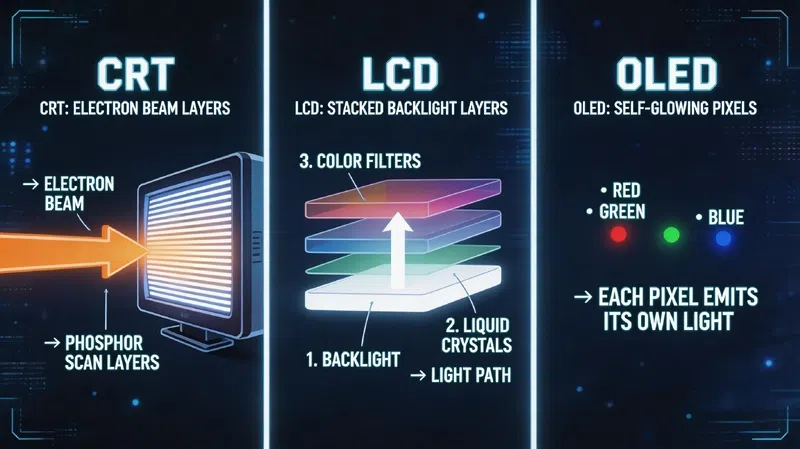
Here’s the clearest breakdown I can offer, stripped of the marketing language:
| Feature | Standard Mini-LED | Micro RGB (Hybrid) | True MicroLED |
|---|---|---|---|
| Light Source | Blue LEDs with color filters | Pure Red, Green, and Blue LEDs | Microscopic LEDs per pixel |
| Panel Type | LCD | LCD (backlit by RGB LEDs) | No LCD panel needed |
| Color Approach | Indirect filtering | Direct RGB at backlight level | Direct RGB at pixel level |
| Burn-In Risk | None | None | None |
| Availability | Mass market | Ultra-premium (55–130 inch) | Extremely limited |
| Price Range | $500–$3,000 | $5,000–$30,000+ | Up to $150,000 |
Standard Mini-LED TVs use blue LEDs as a backlight source, then run that light through color filters to produce the full spectrum you see on screen. It works well and it’s gotten genuinely impressive in recent years.
Micro RGB LED changes the backlight itself. Instead of blue LEDs being filtered into color, you have actual red LEDs, green LEDs, and blue LEDs operating independently behind the LCD panel. The color accuracy improvement isn’t subtle. It covers 100% of the BT.2020 color gamut, which is the widest professional broadcast standard currently in use.
True MicroLED takes it further by eliminating the LCD panel entirely. Each microscopic LED is a pixel. Infinite contrast, no burn-in, absurd brightness. Also still costs around $150,000 for a 110-inch unit. So for the moment, it lives mostly in tech demonstrations and the homes of people who apparently don’t think twice about that price.
What Samsung, LG, and Hisense Are Actually Selling Right Now
Samsung’s Approach
Samsung has arguably pushed Micro RGB LED furthest into the consumer market. Their 115-inch model launched in 2025 and the 2026 lineup expands to sizes from 55 inches all the way to 130 inches. The LEDs themselves are sub-100 micrometers in size, which is genuinely tiny, and they’ve paired the hardware with something called the Micro RGB AI Engine that handles real-time picture processing.
The starting price for the 115-inch was around $30,000 at launch. That’s not a typo.
They’ve also built the “Timeless Frame” design with audio integrated into the frame itself, which sounds like a gimmick until you see how much cleaner the installation looks without a separate soundbar sitting below a screen that thin.
LG’s Version
LG is calling theirs “Micro RGB evo” and positioning it with the phrase “OLED precision,” which is doing a lot of heavy lifting. The idea is that by controlling individual RGB LED backlights at a granular level, you get the kind of per-pixel light control that OLED owners have been bragging about for years, without the burn-in anxiety that comes with OLED panels.
Available in 75, 86, and 100-inch sizes for 2026.
Hisense’s Angle
Hisense went big and loud with their 116UX. 8,000 nits of peak brightness is not a number you see often, and their 165Hz refresh rate makes it genuinely interesting for gaming use cases. They’ve added an AI Chroma Light Sensor that adjusts the picture based on ambient light in the room, which in my experience is either brilliant or annoying depending on whether your room lighting changes throughout the day.
The Intelligence Layer Is Becoming Impossible to Ignore
This is the part that surprised me most when I dug into the specs. These aren’t just better-looking screens. They’re being positioned as home intelligence hubs.
Samsung’s Vision AI Companion, available across their 2026 lineup, lets you ask the TV contextual questions. You’re watching a cooking show and want the recipe. You want a “soccer stadium atmosphere” mode during a match. You want real-time translated subtitles for foreign-language content. The TV generates ambient wallpaper using AI when you’re not watching anything.
I used to think the “smart” in smart TV was mostly a box-ticking exercise. A browser, a few apps, a voice assistant that mishears half of what you say. This feels like something different. Whether it actually improves daily use or just adds complexity is a fair question, and probably one that depends entirely on the person using it.
Samsung has also committed to 7 years of Tizen OS updates for 2026 models, which is a meaningful guarantee for hardware at this price point.

Why It’s Still Expensive and When That Might Change
The honest reason Micro RGB LED TV pricing is still in the stratosphere comes down to manufacturing. The process of placing millions of microscopic LEDs onto a panel, accurately, at scale, without destroying them in the process, is extraordinarily difficult.
The industry calls this the “Valley of Death,” which is a phrase that research firm Yole Développement uses to describe the gap between a technology being proven in labs and it becoming cheap enough for mass production. Companies are working on laser-based transfer methods, interposer substrates, and AI-driven yield management to push costs down. Some projections suggest a potential 5x reduction in production costs as die sizes shrink further.
What that means practically: if you’re looking at a 65-inch Micro RGB display costing $8,000 today, the same quality level could plausibly hit $2,000 to $3,000 within three to five years. That’s still not cheap. But it’s within range of where premium OLED panels sat a few years ago before competition drove prices down.
For now, if you’re comparing options and want a reference point on premium display decisions, this breakdown of OLED vs QLED vs Mini-LED from RTINGS still provides useful context for understanding where Micro RGB sits relative to existing technology. And if picture calibration is something you care about after purchase, the Imaging Science Foundation’s calibration resources are worth knowing about.
If you’re in the middle of a buying decision and trying to figure out whether to buy now or wait, the general rule applies here too: if you need a TV today, buy the best you can afford in the current generation. If you can wait 18 months, the value proposition at every price tier will look noticeably different.
The technology is real. The roadmap is clear. The prices are just still catching up.
❓ FAQs About Micro RGB LED TVs
▶ What is the difference between Mini-LED and Micro RGB LED?
Mini-LED TVs use blue LEDs as a backlight source that gets filtered into color. Micro RGB uses actual red, green, and blue LEDs independently, which produces more accurate color at the backlight level without relying on filters. The result is wider color coverage and better contrast, but at a significantly higher cost.
▶ Is Micro RGB LED the same as true MicroLED?
No. True MicroLED eliminates the LCD panel entirely and uses microscopic LEDs as individual pixels. Micro RGB is a hybrid technology that still uses an LCD panel but replaces the conventional backlight with RGB LED arrays. True MicroLED is far more expensive and currently impractical for most consumers.
▶ Do Micro RGB LED TVs suffer from burn-in?
No. Unlike OLED panels where organic compounds can degrade unevenly over time, Micro RGB LED TVs use inorganic LED elements that do not burn in. This is one of the key advantages being marketed against OLED, especially for users who leave static content on screen for long periods.
▶ How much does a Micro RGB LED TV cost in 2026?
Prices vary by brand and size. Entry points for Micro RGB displays start around $5,000 to $8,000 for smaller sizes. The Samsung 115-inch launched at approximately $30,000. True MicroLED panels remain in a completely different category, with some models priced up to $150,000.
▶ Will Micro RGB LED TVs get cheaper?
Almost certainly, yes. Manufacturing improvements including laser-based LED transfer methods and interposer substrate technology are projected to reduce production costs significantly. Some industry estimates suggest up to a 5x cost reduction as die sizes shrink and yields improve. The timeline is roughly three to five years for meaningful price drops at the consumer level.
▶ Which brands currently sell Micro RGB LED TVs?
Samsung, LG, and Hisense all have Micro RGB or RGB MiniLED products available or announced for 2026. Samsung has the broadest size range (55 to 130 inches). LG’s “Micro RGB evo” targets 75 to 100-inch segments. Hisense competes with the 116UX, notable for its 8,000 nits brightness and 165Hz refresh rate.