
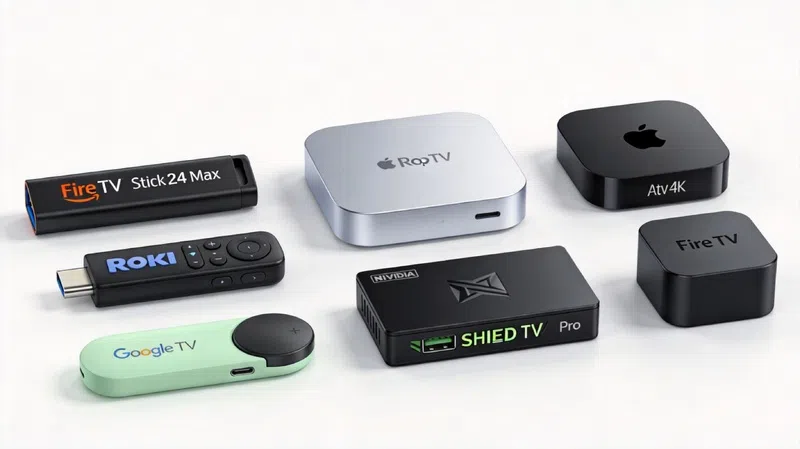
I’ve replaced three streaming sticks in the last two years. Not because they broke — well, one did, but that’s beside the point — mostly because I kept convincing myself the next one would finally feel snappy enough that I’d stop noticing the lag when I’m just trying to get Netflix open before my tea goes cold. Spoiler: the lag never fully disappears. You just get used to a different version of it.
But some devices are genuinely better. And in 2026, the gap between the good ones and the cheap ones has widened in ways that actually matter.
The Ones Worth Talking About
Amazon Fire TV Stick 4K Max
I’ll be upfront — I’ve gone back and forth on Amazon’s ecosystem more times than I care to admit. The ads on the home screen still irritate me. They’ve always irritated me. But the 4K Max, particularly the second-gen version that’s been floating around since late 2023 and has only gotten more refined since, runs genuinely well. Wi-Fi 6E support is part of it. The processor bump is part of it. Mostly it’s just… the thing doesn’t stutter when I’m switching between apps, which sounds like a low bar but trust me, after using the basic Fire Stick for eighteen months, it isn’t.
It’s still Amazon’s walled garden. If you’re in it already — Prime subscription, Alexa habits, that whole world — then this is probably your best sub-£60 option right now.
Roku Streaming Stick 4K
Roku keeps being the answer I give people who don’t want to think about it too hard.
There’s something almost aggressively neutral about the platform. It doesn’t push you toward one service. The remote has shortcut buttons but they’re not obnoxious. The interface is… fine. It doesn’t excite me but it also never makes me want to throw the thing out the window, which I’ve thought about with other devices.
Performance is solid for the price. Not blazing, but solid. For a spare bedroom or a TV that doesn’t get heavy use, the Roku Stick 4K is the kind of thing I’d recommend without much hesitation. It does what it says and then kind of gets out of the way, which is actually a virtue that’s harder to come by than you’d think.
Apple TV 4K (3rd Gen)
Right, so. This one.
I resisted buying an Apple TV for years because the price always felt hard to justify when cheaper sticks technically do the same thing. Then I used one for a month and I understood why people get evangelical about it. The A15 chip — or whatever they’ve quietly updated it to by now — makes the whole experience feel like a different category of product. Menus move like they’re anticipating you. AirPlay works without the usual faff. If you’re in the Apple ecosystem with an iPhone and a MacBook and AirPods, the integration borders on unfair compared to everything else.
But at around £149 in the UK, or $129 in the US, it costs more than some of the services it streams. That’s a real consideration. I’m not going to pretend it isn’t.
It’s the best stick-adjacent streamer you can buy, in my experience. But “best” has to carry some asterisks about your existing setup and what you’re willing to spend.
The Box Territory
Google TV Streamer (2024/2025)
Google quietly ditched the Chromecast branding and launched this — a proper set-top box rather than a dongle — and I think it hasn’t gotten enough attention. It’s got actual local storage, which matters more than people realize once you start using offline features or running apps that cache data. The Google TV interface has matured considerably. A couple of years ago it felt like a beta product that kept rearranging your apps without asking. It’s calmer now.
The remote still has Google Assistant on it, which I use maybe twice a week and ignore the rest of the time. The device itself runs warm but I haven’t had heat-related issues. At around £90, it slots into a weird middle ground — more than a stick, less than an Apple TV — and I think that’s actually where a lot of people’s needs sit too.
NVIDIA Shield TV Pro
This is the one for people who know what they want from a streaming box and want it done properly. The Shield Pro has been around for years in various forms and the current iteration is still the most powerful Android TV device you can buy for home use. Plex server, 4K HDR, Dolby Vision, Dolby Atmos — it handles all of it without breaking a sweat. If you’ve got a NAS drive or a local media collection, nothing else comes close.
It’s overkill for most people. I say that not to sound smug but because I’ve watched people buy it expecting it to transform their Netflix experience, and it doesn’t really do that. The streaming part is fine, obviously. But the Shield Pro earns its £199 price tag in what it does beyond streaming, and if you’re not using those features, you’re paying for something you’ll never touch.
Amazon Fire TV Cube
The Cube is Amazon’s own answer to the “proper box” category. Hands-free Alexa voice control is its main pitch — you can shout at it from across the room and, more often than not, it actually responds correctly. My partner finds this charming. I find it slightly unnerving that I’ve started saying please to the thing out of habit.
Performance is quick. HDMI passthrough is a genuinely useful feature if you’ve got older kit in your setup. The interface is, again, Amazon’s interface — ads and all — but the hardware underneath is noticeably better than the stick range.
Does the OS Matter More Than the Hardware Now?
Honestly, I used to think the chip was everything. Raw performance, processing speed — that’s what separated a frustrating experience from a smooth one. And to some extent that’s still true.
But I’ve started to think the software layer matters just as much, maybe more. Google TV has gotten so much better at surfacing things you actually want to watch across services, which sounds small until you realize how much time you spend scrolling through menus not finding anything. Amazon’s home screen is still mostly a shop with streaming bolted on, but they’ve gotten better at the recommendations. Roku’s approach — just show me everything neutrally — is almost old-fashioned at this point but there’s an audience for it.
Apple’s is probably the most coherent, top to bottom. But you have to want to live there.
Things That Are Still Annoying in 2026
Remote pairing still drops for no reason on multiple devices from multiple manufacturers. I don’t understand why this is still happening. The HDMI handshake issues that cause your display to go black for two seconds when switching inputs — also somehow still a thing. Voice search that confidently misunderstands you and opens something entirely different. These aren’t dealbreakers but they’re a reminder that “streaming” as a seamless experience is still, at best, aspirational.
Also: most of these devices will eventually slow down as apps get heavier. The Fire TV Stick I had in 2022 was fine until around 2024 when it started struggling. Something to factor in if you’re buying at the budget end — you’re probably on a two to three year cycle whether you want to be or not.
Who Should Buy What
If budget is the primary thing: Roku Stick 4K. It’s not flashy but it’s honest about what it is.
Deeply embedded in Amazon’s world already: Fire TV Stick 4K Max, no real debate.
Apple household, willing to pay: Apple TV 4K, and you’ll probably not regret it.
Want a proper box with some flexibility: Google TV Streamer sits in a good spot for most people.
Power user with local media: NVIDIA Shield Pro. Don’t overthink it.
I keep meaning to try one of the newer smart TV operating systems built directly into sets — Samsung’s Tizen, LG’s webOS — to see if they’ve gotten good enough to make external devices irrelevant. I suspect they haven’t, not really. But maybe I’m wrong about that. I’ve been wrong about streaming hardware before.