
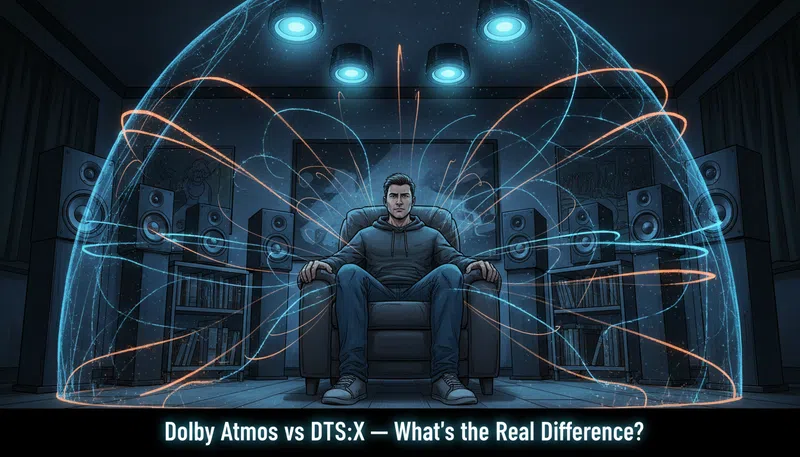

I used to think audio formats were one of those things only obsessive home theater people argued about on forums at midnight. Then I bought a new receiver and spent three weekends trying to figure out why things sounded… off. Not bad, just not what I expected after reading all those spec sheets.
That rabbit hole led me here.
The Part Nobody Explains Clearly
Both formats are trying to do the same fundamental thing — make sound feel like it exists in a space around you, not just left and right. The way they go about it, though, is genuinely different. And depending on your room and how you watch things, that difference actually matters.
Dolby Atmos works by treating individual sounds as objects. A helicopter isn’t locked to your left speaker — it has coordinates. X, Y, Z. The system figures out which speakers should handle it based on where they are in the room. It supports up to 128 of these objects at once, which sounds absurd, but for a dense action scene with rain, explosions, crowds, and dialogue all happening simultaneously, it starts making sense.
DTS:X takes a more relaxed approach. It’s built on an open-source platform and caps out at 32 objects — still a lot — but the bigger difference is that it doesn’t care where your speakers are. It adapts. If your setup is slightly asymmetrical because of a weird corner or a door that’s in the wrong place, DTS:X quietly adjusts instead of quietly failing.
That flexibility is genuinely useful for people who don’t have a purpose-built home theater room, which is most of us.
Setup: Where It Gets Real
Here’s the thing with Atmos — the spec sheet and the real world sometimes feel like different documents.
Getting Atmos Right Is Specific
To hit what Dolby calls the reference experience, you’re aiming for a 7.1.4 configuration. That means height speakers, either ceiling-mounted or upward-firing, positioned at roughly 45 degrees from your listening position. They want them between 30 and 55 degrees elevation. Your ceiling should be between 7.5 and 14 feet for the bounce effect to actually work with upward-firing speakers.
It’s precise. Maybe more precise than most living rooms allow.
DTS:X Doesn’t Mind the Mess
DTS:X runs on automatic calibration. You can have speakers that aren’t perfectly placed, and its Neural:X upmixing will work with what you’ve got — theoretically extracting up to a 30.1 channel experience from a standard base track. In my experience, this sounds more impressive on paper than it does in practice, but the point stands: it’s forgiving.
There’s also a feature that lets you manually adjust dialogue volume independently from the rest of the mix. That one’s actually useful. Anyone who’s ever cranked a movie to hear whispered conversations and then been deafened by the score knows what I mean.

Dolby Atmos vs DTS:X: Head to Head
| Feature | Dolby Atmos | DTS:X |
|---|---|---|
| Max Audio Objects | 128 | 32 |
| Speaker Flexibility | Strict layout needed | Adapts to existing setup |
| Height Channels | Required | Optional |
| Streaming Support | Strong (major platforms) | Limited |
| Blu-ray Presence | Yes | Yes (IMAX Enhanced) |
| Dialogue Control | No independent control | Yes |
| Calibration Method | Precise manual placement | Automatic |
| Gaming Latency | Can lag in low-latency modes | Generally lower latency |
The Streaming Problem Nobody Talks About
This is where Dolby Atmos quietly runs away with the market, and it’s not really about audio quality.
It comes down to codec efficiency. Atmos content on major platforms rides on Dolby Digital Plus, which is bandwidth-efficient enough to stream without massive file sizes. DTS doesn’t have an equivalent mid-range lossy codec that competes at that level — which means DTS:X stays mostly on physical discs. If you’re a Blu-ray collector, that’s fine. If most of what you watch comes from an internet connection, the library difference is significant.
According to Dolby’s own developer documentation, Atmos is now embedded across most major streaming services by default. DTS, meanwhile, is fighting a content availability problem that no amount of technical superiority fixes on its own.
That said, hardware isn’t really the issue. Most modern AV receivers from manufacturers like Denon, Marantz, and Yamaha support both formats natively. You’re not choosing between ecosystems when you buy the receiver — you’re choosing based on what you actually watch. See this breakdown from SoundGuys for a more hardware-focused perspective.
Gaming Is a Different Conversation Entirely
Atmos Has the Bigger Library
For modern AAA games, Dolby Atmos support is more common. The integration with Windows 11 and Xbox is baked in, and developers have leaned into it heavily. The positional audio in supported titles is genuinely impressive — you can often tell the difference between a sound coming from above versus behind in ways that older formats couldn’t pull off.
DTS:X Has the Latency Edge
Here’s where it gets a bit messy. A meaningful number of users report audio lag with Atmos when running in ultra-low latency modes on Windows and Xbox. It’s not universal, and it’s not always dramatic, but in competitive gaming where milliseconds matter, some people have switched back to DTS:X specifically because of this.
DTS:X also tends to get described as “sharper” for high-frequency sounds — footsteps, environmental cues, that kind of thing. Whether that’s objectively better or just different is genuinely up for debate. I’ve seen people swear by it for titles like Red Dead Redemption 2 for directional echo in open environments.
For reference, Digital Trends has covered the gaming audio latency issue in some depth if you want a technical breakdown.

What’s Coming Next — And Why It Matters
There’s a codec proposal worth knowing about called the Stem-Native Codec (SNC). It doesn’t store a fully rendered audio mix — it stores components. Vocals, drums, bass, ambience — each encoded separately, then assembled during playback. The result is files that are reportedly 38% smaller than FLAC while still supporting spatial positioning and adaptive adjustments based on your playback environment.
Whether SNC becomes a real-world standard or stays a research paper is genuinely unclear right now. But the direction it points — toward flexible, element-based audio that doesn’t require proprietary hardware or locked ecosystems — feels like where things are heading eventually. You can read more about emerging audio codec research at AES (Audio Engineering Society) and Hydrogen Audio’s community forums if that’s your kind of rabbit hole.
So Which One Should You Actually Choose
Honestly, for most people in 2026, Dolby Atmos is the practical answer — not because it’s technically flawless, but because the content library makes it hard to justify optimizing for anything else. If everything you want to watch comes with an Atmos track, that’s the format that matters.
But if you’ve got an existing speaker setup that isn’t perfectly positioned, or you play a lot of competitive games where latency is measurable, or you buy 4K Blu-rays regularly — DTS:X earns its place. Its flexibility is real, not marketing language.
The format war framing is a bit misleading anyway. Most receivers support both. You’ll probably end up using whichever one the disc or stream hands you, and on a properly calibrated system, both sound noticeably better than whatever you were listening to five years ago.
The speakers matter more than the format. That’s the part people keep learning the expensive way.