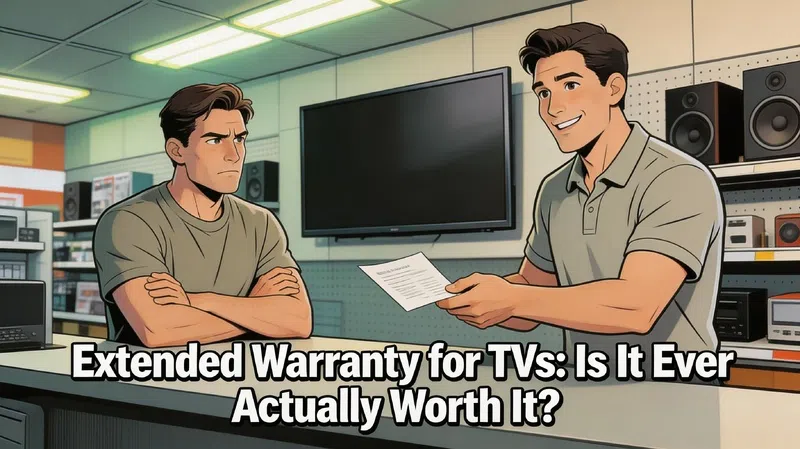

I remember standing at the checkout, TV already paid for, and the guy behind the counter looked at me with this practiced calm and said, “Would you like to add protection for just a few dollars a month?” I said yes. Didn’t even think about it. The TV lasted nine years without a single issue, and I paid roughly $180 for a plan I never once used.
That’s not a horror story. But it’s also not a success story. It’s just money that quietly disappeared.
The question of whether an extended warranty for TV is worth buying is one of those things that sounds simple and turns out to be genuinely complicated — depending on what type of TV you have, where you bought it, and whether you even know what credit card is sitting in your wallet right now.
The Math Nobody Shows You at the Register
Here’s something that took me a while to actually sit down and look at. The median cost of an extended TV warranty plan is around $136. The average cost of a TV repair — when something actually goes wrong — is roughly $156. So in pure dollar terms, you’re paying close to the cost of a repair upfront, on the chance that you’ll need one.
Retailers know this. It’s not a conspiracy, it’s just math. These plans are some of the highest-margin products in the store. One consumer protection study described them plainly: for standard televisions, extended warranties are essentially “pure profit” for the retailer. The component most likely to fail — a power supply or a backlight board — usually costs somewhere between $50 and $100 to replace. That’s not $136 worth of risk.
But honestly, that’s not the whole picture. And the part that’s missing matters quite a bit.
Why the Warranty Window Often Misses the Point
There’s a concept in reliability engineering called the bathtub curve. It sounds absurd but it’s genuinely useful. The basic idea: consumer electronics tend to fail either very early (within the first 30 days — manufacturing defects, bad components) or very late (after 7+ years, when the device just wears out). The long, flat middle section of the curve? That’s where almost nothing happens.
This is a problem for extended warranties, which typically cover years two through five.
Your manufacturer warranty already covers year one. By year two, if the TV survived, odds are decent it’ll survive a while longer. And by the time your extended warranty expires around year four or five, you’re not even close to the typical wear-out period. So the plan covers the period when failure is statistically least likely.
The “Dead Zone” of Coverage
Most failures that feel dramatic — a motherboard fried by a power surge, screen damage, physical accidents — aren’t covered by standard plans anyway. Extended warranties usually mirror the manufacturer’s terms. No accidental damage. No power surges unless you add that separately. No cosmetic issues.
So you’re paying to cover a slim window where almost nothing goes wrong, for problems that were probably going to be cheap to fix anyway.
That said. There is one enormous exception.
LED vs OLED: This Is Where Everything Changes
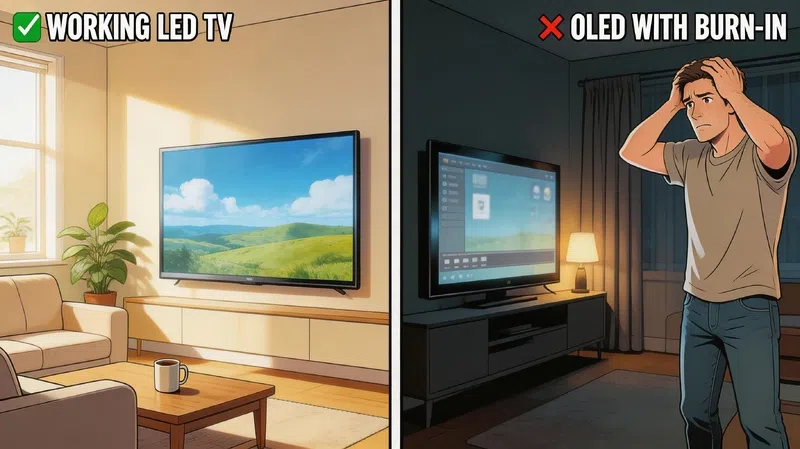
If you have a standard LED or LCD television, the conventional wisdom holds. Extended warranties for LED TVs are rarely worth the cost. The panels themselves are relatively durable, repairs are modular and affordable, and third-party technicians can often fix common issues without much drama. You don’t need $136 of protection for a component that costs $60 to replace.
For LED Owners
Skip the extended warranty. Use the manufacturer’s first year. After that, if something breaks, get a repair quote first — you’ll probably be surprised how cheap it is. The one thing worth doing: check your credit card. More on that in a second.
For OLED Owners — This Is Different
OLED panels cannot be repaired. That’s not a simplification. When an OLED panel degrades, gets burned in, or fails structurally, the only fix is a full panel replacement — and that replacement often costs as much as buying a new television. Sometimes more, depending on the size.
This changes the math dramatically. If you paid $1,800 for an OLED and the panel costs $1,400 to replace in year three, suddenly that $200 protection plan looks like one of the smarter purchases you made.
The other factor: OLED panels are genuinely susceptible to burn-in — that ghosting effect from static content like news tickers, gaming interfaces, or channel logos. In humid climates, some LG and Samsung OLED panels have shown oxidation damage within two to three years. These aren’t theoretical concerns.
Comparing Your Actual Options
| Protection Type | Cost | OLED Burn-In Covered | Duration | Best For |
|---|---|---|---|---|
| Manufacturer Warranty | Free | No | 1 Year | Everyone |
| Costco Concierge | Free (members) | No | +1 Year | Costco buyers |
| Costco + SquareTrade Add-on | Paid | No | Up to Year 5 | LED buyers only |
| Best Buy Protection Plan | Paid | Yes | 2–5 Years | OLED buyers |
| Credit Card Extension (Citi Strata Premier) | Free (card fee) | Mirrors manufacturer | +24 Months | Smart card users |
| SquareTrade / Allstate (3rd Party) | Paid | Usually No | 2–3 Years | Budget-conscious |
The standout detail in that table: Best Buy is one of the very few retailers that explicitly covers burn-in and pixel repair under their paid protection plans. For an OLED buyer, that distinction alone might make them the better place to purchase.
Costco’s coverage is generous in many ways — members get a free second year through their Concierge service, and the theoretical stack of protections can reach seven years — but their documents confirm no burn-in coverage. For OLED, that’s a meaningful gap.

The Credit Card Option Most People Completely Ignore
This one genuinely surprises people. Many mid-to-premium credit cards automatically extend the manufacturer’s warranty by one to two years at no additional cost. You don’t opt in. You just buy the TV on the right card, keep your receipt, and the coverage is there if you need it.
The Citi Strata Premier Card currently adds 24 months to the original warranty — the longest extension available from any major card, up to $10,000 per item. The American Express Gold and Platinum cards add 12 months on warranties of five years or less, also up to $10,000 per item. Chase Sapphire Reserve adds 12 months on warranties of three years or less.
In practice, this means an LED TV purchased on a Citi Strata Premier gets three years of coverage — one from the manufacturer, two from the card — for exactly $0 extra. For most LED buyers, that’s sufficient.
The filing process, especially with American Express, is reportedly straightforward — keep your original receipt, your card statement showing the purchase, and the warranty document. That’s it.
One important note: credit card warranties don’t cover accidental damage, and they won’t help with burn-in either. They mirror what the manufacturer covers, just for longer. For OLED owners, this still leaves the burn-in gap open.
What About SquareTrade and Third-Party Plans?
It’s mixed, honestly. Some users report fast, painless resolutions — SquareTrade in particular has a reputation for settling claims quickly. The catch: they often reimburse via store-specific gift cards rather than cash or direct replacement, and the reimbursement is capped at the original purchase price, not including taxes.
So if your $1,200 TV fails and you’re issued a $1,200 Walmart gift card, that’s technically fine — but it’s not the same as a check. Worth knowing before you sign up.
For deeper research on protection plan reliability, Consumer Reports and NerdWallet’s warranty comparison guides are worth a look before committing to any third-party plan.
One Last Thing Worth Mentioning
If you live somewhere humid — coastal areas, tropical climates, anywhere with significant seasonal moisture — the calculus for OLED protection shifts even further. Heat trapped by dust in TV vents is a quiet killer for internal components over time. Cleaning those vents occasionally and keeping the TV away from direct humidity sources isn’t glamorous advice, but it probably does more for longevity than any warranty plan.
A good surge protector or UPS unit is worth more than most people give it credit for too. A single voltage spike can fry a motherboard in a way that no warranty covers unless you specifically added that rider.
The point isn’t that warranties are useless. For a $2,000 OLED in a humid apartment with a toddler in the house? Get the Best Buy plan with burn-in coverage. But for a mid-range LED in a stable environment? The math just doesn’t hold up the way the salesperson implies it does.
That $180 I spent in 2017 still bothers me a little.