
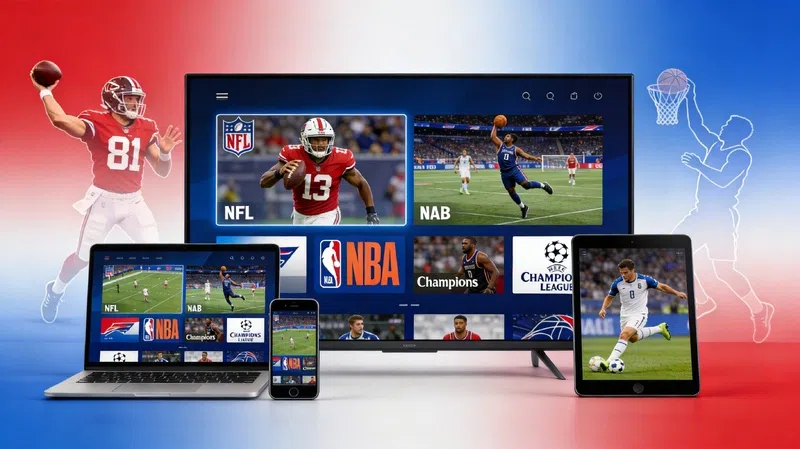
There was a point where cutting cable felt like you were giving something up. Like you were choosing convenience over actually watching the things you cared about. For sports fans especially, that trade-off felt real — NFL Sundays, late-night NBA games, and Champions League knockout rounds felt locked behind a wall you’d just handed back the key to.
But that’s not really the situation anymore. Not even close.
The Streaming Platforms That Actually Cover the Big Leagues
What works depends more on which sport you care about
For NFL coverage, YouTube TV remains one of the more complete options out there. It carries local CBS and Fox affiliates, plus ESPN and NFL Network, which together cover a large chunk of the regular season. The price has gone up, but so has the library. If you’re mainly an NFL fan, it often feels like the most straightforward path.
NBA fans have a slightly different situation. NBA League Pass — available directly through the league at nba.com/league-pass — gives you access to out-of-market games, though blackout restrictions still apply in your local market. In my experience, pairing League Pass with a streaming service that carries ESPN and TNT — like Hulu + Live TV or DirecTV Stream — tends to fill the gaps better than any single subscription alone.
For the Champions League specifically, Paramount+ holds the streaming rights in the US through at least the mid-2020s. The games are there, they’re live, and the coverage is generally decent. You can check current pricing and packages directly at paramountplus.com.
Free and Low-Cost Options That Are Still Legitimate
The stuff people overlook because it doesn’t cost anything
Peacock occasionally carries NFL playoff games and some Premier League matches. It’s not comprehensive, but for the price — they have a free tier, though the sports tend to sit behind the paid plan — it’s worth keeping installed. NBC Sports content tends to live here now.
Tubi and Pluto TV don’t carry live NFL or NBA, but they do have some archive content and are fully legal and free. That’s not always the case for other free sites that turn up in searches, so it’s worth noting.
The NFL also has its own free streaming option on NFL+, which covers live local and prime-time games on mobile devices. It’s a limited viewing experience on a phone screen, but it exists. Details are at nfl.com/plus. It tends to work well enough when you’re not near a TV.
Devices and What You Actually Need to Get Set Up
You probably already have most of this
A smart TV, a Roku, an Amazon Fire Stick, or an Apple TV will get you into most of these services without any extra friction. The apps for YouTube TV, Hulu + Live TV, Paramount+, and Peacock all exist across these platforms and generally work reliably. This tends to be where people overthink it — the setup is less complicated than it sounds.
One thing worth mentioning: Hulu + Live TV bundles Disney+ and ESPN+ into the subscription now, which makes it a reasonable all-in-one for sports fans who want a wider net. ESPN+ specifically carries some Champions League matches, MMA, and a significant amount of college sports. It’s not a replacement for a full cable package, but it often feels like it comes close, depending on what you’re watching.
You can browse the current Hulu Live TV plan at hulu.com/live-tv.
The International Viewer Problem (and Some Honest Answers)
Geographic restrictions are real and annoying
If you’re outside the US, the streaming rights map shifts considerably. Champions League coverage in the UK sits primarily with BT Sport / TNT Sports, now under Discovery’s umbrella. In many European countries, the matches are split across two or three providers depending on the round and the teams involved. It’s not a clean situation.
For NBA international viewers, the league offers regional streaming packages through local broadcasters and sometimes through the League Pass international tier. But that’s not always the case for live games in every region — some markets still have blackout issues even internationally.
The honest answer here is: check what’s licensed in your specific country before subscribing to anything. Streaming rights are genuinely regional and change when contracts renew. The official league websites usually have a “watch” or “broadcast partners” section that lists current local options.
What to Know Before Subscribing to Anything
Monthly costs add up faster than you might expect
YouTube TV is currently around $72–73 per month. Hulu + Live TV sits in a similar range. DirecTV Stream varies by tier. None of these are cheap, and if you’re stacking Paramount+ on top for Champions League and NBA League Pass for out-of-market games, you could find yourself approaching what a cable bill used to cost you — sometimes exceeding it.
The calculus that makes this work is flexibility. You can subscribe to Paramount+ only during Champions League knockout rounds and cancel otherwise. Same with NFL+ if you only need the mobile experience during the regular season. That kind of seasonal subscribing isn’t always possible with traditional cable, and in my experience it’s where the cord-cutting model actually saves money over the course of a full year.
DirecTV Stream tends to carry more regional sports networks than competitors, which matters for certain NBA markets where the local RSN carries the home team. Worth checking at directv.com/stream if local games are a priority for you.
Most of these services offer a free trial, usually seven days. That’s often enough time to test whether the app performs well on your setup before committing.
The sports are out there. The rights are fragmented, yes, and occasionally frustrating to navigate — but the games themselves aren’t really locked away anymore. You just need a clearer map of where they live.