
There’s a specific kind of frustration that comes from owning a smart lock that only works with one app, on one phone ecosystem, with one manufacturer’s cloud service, and absolutely nothing else. You buy the lock. You download the app. You create yet another account. Six months later the company gets acquired and the app stops working.
I’ve been through that cycle. Most people in this space have.
That’s the problem Aliro is trying to fix, and from what I can tell, it’s the first attempt in a long time that actually has enough industry weight behind it to stick.
What Aliro Actually Is
The Aliro 1.0 specification was published in early 2026 by the Connectivity Standards Alliance, which is the same organization behind the Matter smart home standard. Over 200 companies contributed to building it, including some names you’d recognize immediately.
The core idea is straightforward. Right now, digital keys are fragmented. Apple has its Home Key system. Google has its own approach. Samsung has another. Lock manufacturers have to build separate integrations for each one, which means higher costs, slower development, and inevitably a situation where your phone works with this lock but not that one.
Aliro creates a single, shared language. One credential format. One communication protocol. A lock certified under Aliro should work whether you have an iPhone, an Android device, or eventually a wearable. The user experience across all of them becomes consistent, the same way contactless payments feel the same regardless of what card or phone you use.
That analogy to tap-to-pay is intentional, by the way. The cryptographic security model Aliro uses is the same category of technology that protects your bank transactions.
The Security Architecture (Without the Headache)
Traditional access control systems often share a master secret key across all their hardware. If that key gets compromised, everything needs to be re-keyed. Every lock. Every badge. Every reader. It’s a significant vulnerability that the industry has been aware of for years and largely ignored because replacing the infrastructure was expensive.
Aliro uses asymmetric cryptography instead. Specifically, Elliptic Curve Cryptography on the NIST P-256 curve. Each credential holds a unique private key. The lock verifies identity through a mathematical challenge-and-response process rather than by sharing a secret. Even if someone intercepts the exchange, they get nothing useful.
This is the same category of cryptography securing most modern financial transactions.
What this means practically: if one credential is compromised, only that credential needs to be revoked. The rest of the system stays intact. For property managers, hotels, and offices managing hundreds or thousands of access points, that’s a meaningful operational difference.
How the Wireless Side Actually Works
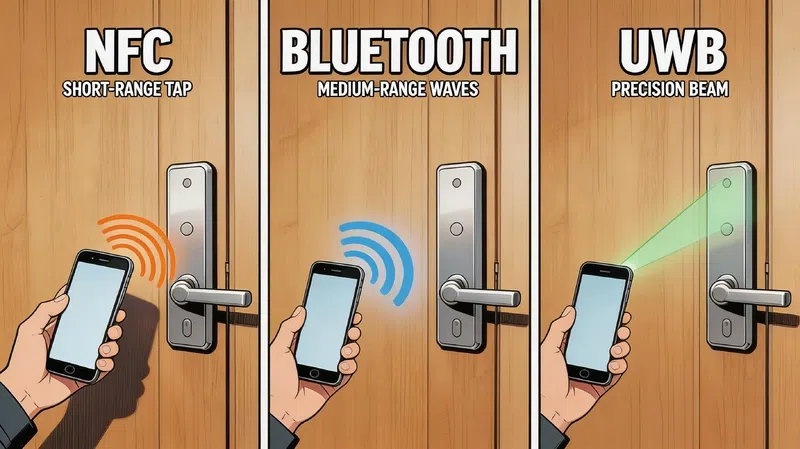
Aliro supports three different wireless technologies, and which one activates depends on what your lock supports and what you’re trying to do.
| Technology | How You Use It | What It Enables |
|---|---|---|
| NFC | Tap your phone to the reader | Basic unlock, works like a contactless card. Required for Aliro certification. |
| Bluetooth LE | Device detects the lock nearby | Longer range, device pairing, works when phone is in your pocket |
| Ultra-Wideband (UWB) | Walk toward the door | Precise distance sensing, hands-free unlock as you approach |
The UWB piece is what gets genuinely interesting. Unlike Bluetooth, which can be triggered from meters away and has been exploited in relay attacks on car keyless entry systems, UWB measures exact distance with centimeter-level precision. The lock knows you’re standing two feet away, not sixty. That makes hands-free unlocking secure in a way that Bluetooth-based versions never quite were.
Express Mode is another feature worth knowing about. It allows unlocking without waking or authenticating the device first, similar to how transit cards work in Apple Wallet. For a front door you’re walking through ten times a day, that level of friction reduction actually matters.
One thing I found notable in the spec: Aliro is designed to work offline. No network connection required at the moment of unlock. In elevators, underground parking garages, or anywhere with poor signal, the credential still works because the cryptographic verification happens locally between the phone and the reader. That’s a detail that matters for real-world deployment and one that a lot of proprietary smart lock systems have struggled with.
How Aliro Fits With Matter
If you’ve been following smart home standards at all, you’ve heard of Matter. They come from the same organization and people often lump them together, but they do completely different things.
Matter is about controlling devices. Checking lock status. Sending a remote lock command from your phone. Integrating your lock into a broader home automation routine.
Aliro is about identity at the door. Who is allowed through, how their credential is verified, and what happens in that fraction of a second between approach and access.
A useful way to think about it: Matter decides what the lock can do. Aliro decides who gets to use it.
For a properly built smart lock in 2026, you’d ideally want both. Matter handles the smart home integration side. Aliro handles the access credential side. They’re complementary layers, not competing ones. The CSA’s official Aliro overview explains the relationship in more depth if you want the technical detail.
What This Means If You’re Thinking About a Smart Lock Right Now
Honestly, if you’re in the middle of choosing a smart lock, Aliro certification is worth waiting for. Not because existing locks are bad, but because the first wave of Aliro-certified hardware is arriving now, and buying a proprietary system right before an open standard ships tends to feel frustrating in retrospect.
Companies like Aqara, Kwikset, Nuki, and HID are among the early expected certification recipients. The Aqara U400 specifically supports both UWB and NFC, which gives you the full range of Aliro’s capabilities rather than just the baseline tap-to-unlock.
For renters or anyone who can’t replace a physical lock, there are also devices designed to retrofit Aliro support onto existing hardware, which is a more practical option than ripping out a deadbolt.
The broader shift matters beyond individual products though. A hotel that adopts Aliro-compatible readers doesn’t need to issue physical keycards anymore. A university doesn’t need a separate app for building access. An office building doesn’t need to choose between supporting Android and iOS users. Assa Abloy’s digital key research gives a sense of how access control vendors are thinking about this transition at the commercial scale.

The Problem It’s Still Solving
The fragmentation issue in access control runs deeper than most people realize. Manufacturers were previously building separate firmware and software integrations for Apple, Google, and Samsung independently. That multiplied development costs, slowed hardware releases, and made it nearly impossible to guarantee consistent behavior across ecosystems.
From the manufacturer’s side, Nordic Semiconductor’s multiprotocol SoC documentation shows how modern chips are being designed to handle Aliro, Matter, and other protocols simultaneously on a single piece of silicon. That efficiency on the hardware side is what makes the economics of building certified devices viable for smaller lock manufacturers who previously couldn’t afford multiple proprietary integrations.
Adoption is still early. Most consumers won’t hear the word “Aliro” for another year or two. They’ll just notice that their phone works with the new lock in their building lobby, or that checking into a hotel no longer involves waiting at a desk for a plastic card.
That invisibility is the point. The best infrastructure is the kind you never have to think about.
FAQs About the Aliro Digital Key Standard
Q: Does Aliro work on both Android and iPhone? A: Yes. That’s one of the core goals of the standard. Aliro is designed to work with native digital wallets across both ecosystems, so households or offices mixing Android and iOS devices can use the same Aliro digital key infrastructure without compatibility issues.
Q: Do I need an internet connection for Aliro to work? A: No. Aliro is designed to function offline. The cryptographic verification happens locally between your device and the reader, so underground parking garages, elevators, or areas with poor signal don’t break the experience.
Q: How is Aliro different from Apple Home Key? A: Apple Home Key is a proprietary implementation that works only within the Apple ecosystem. Aliro is an open standard that works across manufacturers and mobile platforms. An Aliro-certified lock can accept credentials from Apple, Google, and Samsung wallets using the same hardware.
Q: Is Aliro secure enough for commercial use? A: The standard uses Elliptic Curve Cryptography on the NIST P-256 curve, the same category of cryptography used in banking and tap-to-pay systems. It also uses asymmetric key architecture, meaning a compromised credential doesn’t affect the rest of the system.
Q: What happens if my phone battery dies? A: Most Aliro-certified implementations will support NFC power-reserve modes similar to how Apple Pay works when battery is critically low. Physical backup options like PIN pads or traditional key cylinders are also expected to remain part of certified hardware for this reason.
Q: Can I share an Aliro digital key with someone else? A: Secure key sharing is listed on the Aliro roadmap for future specification updates. The current 1.0 release focuses on establishing the core credential and communication framework. Shared access features are expected to arrive in subsequent versions.
Q: When will Aliro-certified locks be widely available? A: The 1.0 specification was released in early 2026, and the first wave of certified hardware from companies like Aqara, Kwikset, and Nuki is expected throughout 2026. Wide availability at retail scale will likely follow in 2027 as more manufacturers complete certification testing.